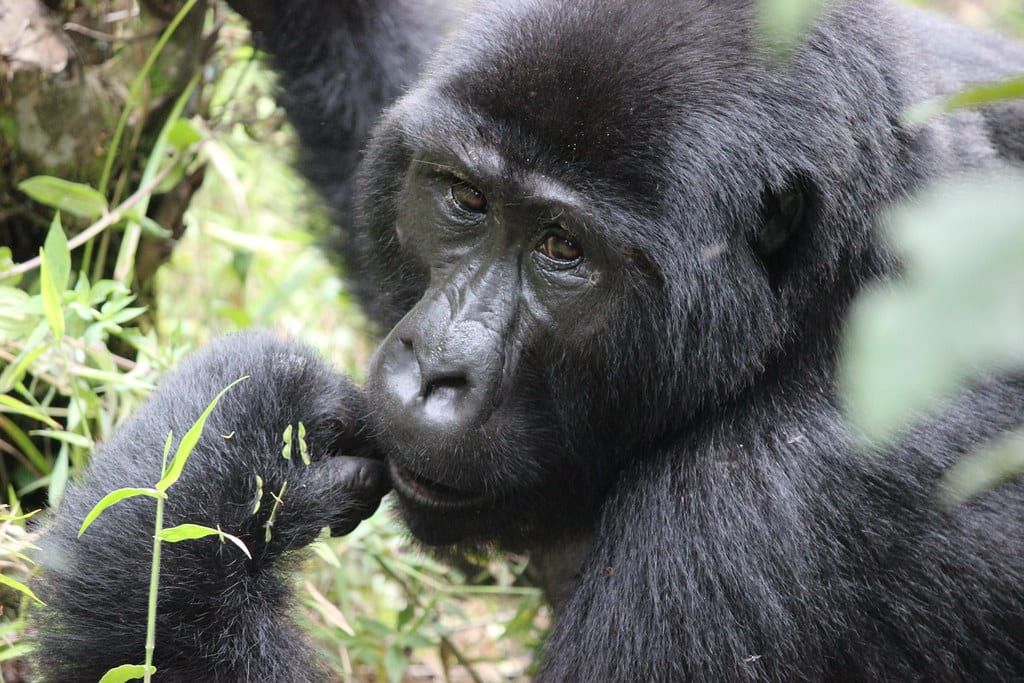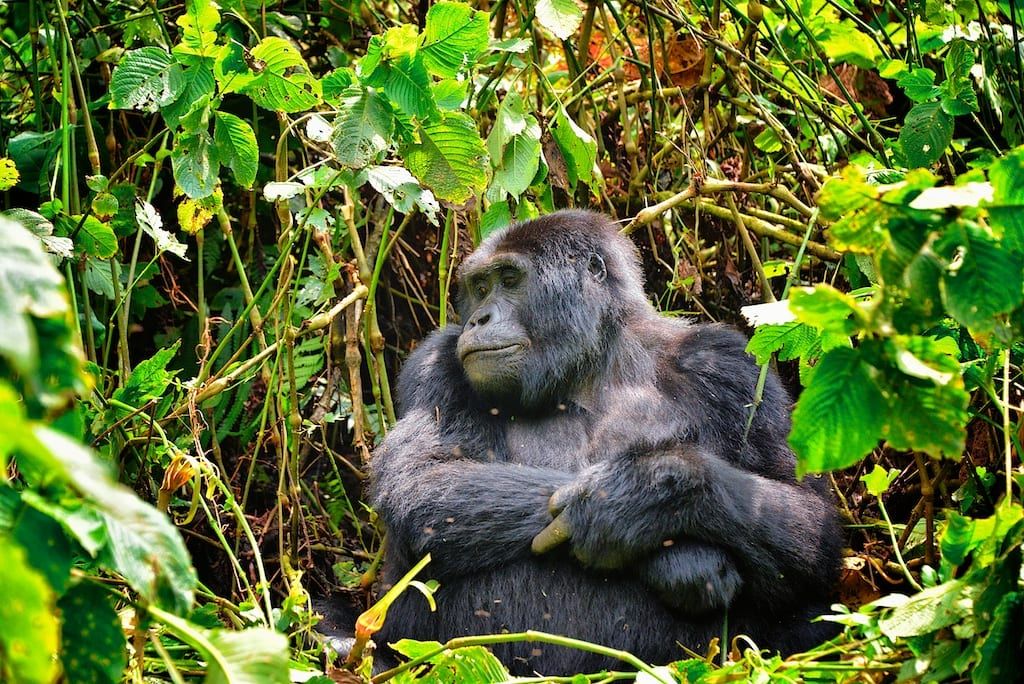
Roughly 459 mountain gorillas live in the steep rainforest of Bwindi Impenetrable National Park — close to half of all that remain on Earth. Trekking to see them means hiking between two and eight hours through mud, nettles and vines, then standing seven metres... in fact, ten metres by current Uganda Wildlife Authority rules, from a wild silverback that outweighs you four times over. This guide covers everything the planning actually hinges on: permit costs and booking windows, the four trekking sectors, how to get there, what trek day looks like, and what the whole trip costs beyond the $800 permit.
Bwindi Gorilla Trekking at a Glance
Bwindi is a 331 km² montane and lowland rainforest in Uganda's south-western Kigezi Highlands, on the edge of the Albertine Rift, and it holds more habituated mountain gorilla families than anywhere else on Earth. Around 20 families are open to tourism across four sectors, with a strict ceiling of 8 visitors per family per day — which is exactly why permits sell out months ahead. Gorilla tourism here began in April 1993, when the Mubare group became the first family habituated for visitors in Uganda.
- Permit: $800 (foreign non-resident)
- Group size: 8 visitors per family, 1 hour with the gorillas
- Trek length: 2–8 hours, occasionally longer
- Minimum age: 15 years, checked against passports
- Sectors: Buhoma, Ruhija, Rushaga, Nkuringo
- Sighting success: an estimated 95–98%
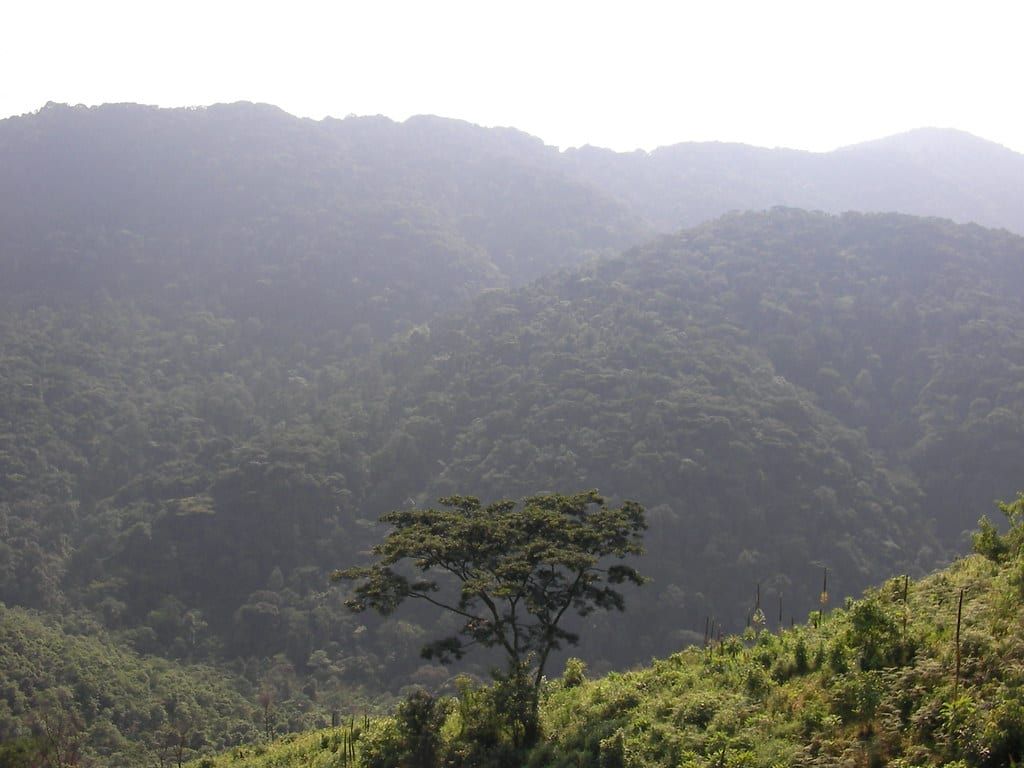
The "impenetrable" in the name is literal. The forest is a Pleistocene survivor — its vegetation is more than 25,000 years old — with a canopy so dense and undergrowth so thick that leaving the trail means pushing through nettles and vines on slopes that drop into river valleys. It's also one of Africa's most biodiverse forests: over 200 tree species, 120 mammals, 347+ birds and some 202 butterflies. UNESCO listed it as a World Heritage Site in 1994. For the backstory of the park and its people, see our guide to Bwindi's history and highlights.
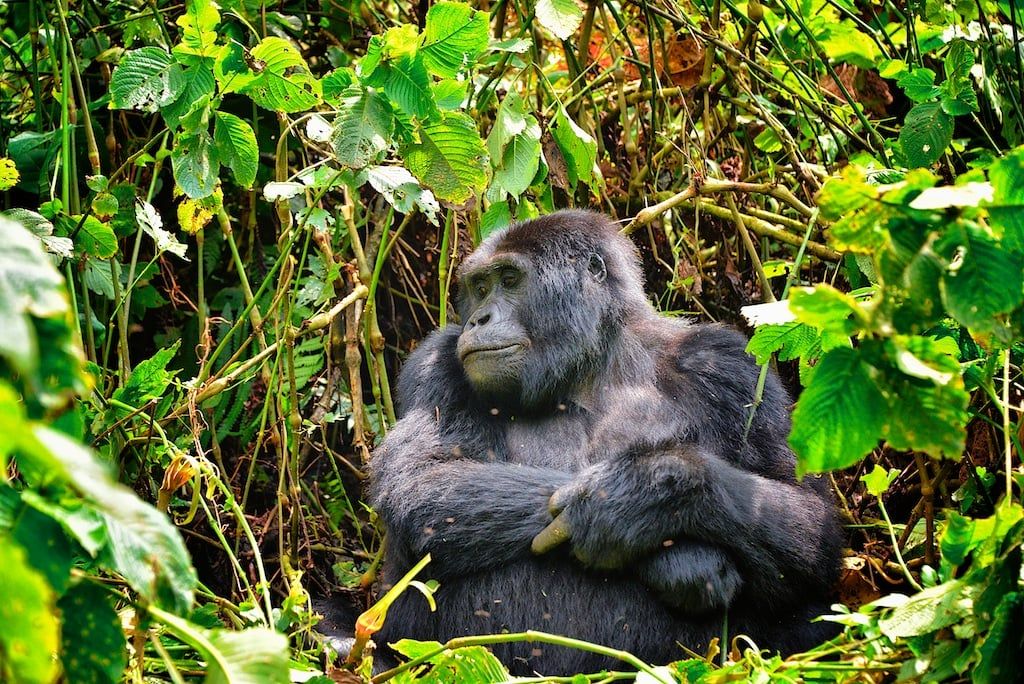
Gorilla Permits: Cost, Booking and the Habituation Alternative
The permit is the single biggest line in your budget and the thing to sort first. Under the UWA conservation tariff running July 2024 to June 2026, prices are fixed by residency category:
| Category | Standard trek | Habituation experience |
|---|---|---|
| Foreign non-resident | US$800 | US$1,500 |
| Foreign resident | US$700 | US$1,000 |
| Rest of Africa | US$500 | US$1,000 |
| East African citizen | UGX 300,000 | UGX 750,000 |
For comparison, Rwanda's Volcanoes National Park charges $1,500 for the same experience. That $700 difference is why Uganda — and Bwindi specifically — is where most trekkers end up.
Booking goes through two channels: the UWA central reservations office in Kampala, or a licensed tour operator. Booking direct means handling bank transfers yourself and matching permit date, sector and lodge by hand; an operator checks real-time availability and bundles permit, lodging and transport — most gorilla trekking tours are sold this way, usually with a small surcharge. Either way, book early: 6–12 months ahead for June–September and December–February, 3–6 months for the quieter months. Permits are non-refundable and non-transferable, and UWA states fees can change without notice — confirm the current price shortly before you pay.
The permit covers the trek itself: ranger guiding, that day's park entrance, a community levy and your tracking certificate. It does not cover transport, lodging, porters, tips, or park entry on any other day you spend in Bwindi.
Then there's the upgrade. The Gorilla Habituation Experience replaces the standard trek with a full day alongside researchers and rangers as they work with a semi-habituated family — and it exists only in the Rushaga sector.
| Standard trek | Habituation experience | |
|---|---|---|
| Time with the gorillas | 1 hour | Up to 4 hours |
| Visitors per day | 8 per family | 4 per family |
| Price (foreign non-resident) | $800 | $1,500 |
| Where | All four sectors | Rushaga only |
| What you see | Fully habituated family | Semi-habituated family, researchers at work |
| Duration | 2–8 hours total | Most of a full day |
Is it worth double the money? If gorillas are a once-in-a-lifetime trip and you care about behaviour, yes — four hours with a family teaches you more than one hour ever can. If you just want the encounter, the standard trek delivers it for $700 less.
Choosing Your Sector: Buhoma, Ruhija, Rushaga or Nkuringo
Here's the mechanic most first-timers miss: your permit is tied to one sector, and driving between sectors takes hours on rough roads. Choose the sector first, then book the permit, then book a lodge near that sector's briefing point for the night before the trek. Get the order wrong and you'll be facing a 4 am transfer.
Buhoma
The original sector, in the north, and still the most developed. Trekking families include Mubare, Habinyanja, Rushegura, Muyambi and Katwe, and the terrain at this lower altitude is the gentlest in the park — a reasonable pick for less confident hikers and the sector most seniors trek from. The lodge scene is the widest too, from Sanctuary Gorilla Forest Camp to Mahogany Springs, and Buhoma has the park's main village and community walks at the gate. First trek, average fitness, or traveling with older parents: book Buhoma.
Ruhija
The quiet, high-altitude sector on the park's eastern side. Families include Bitukura, Oruzogo, Mukiza and Kyaguliro, and the treks feel further from the crowds. The draw for birders is serious: the Mubwindi Swamp trail is one of the best places on Earth to see the African green broadbill. Bwindi records 347+ bird species and 22 of the Albertine Rift's 36 montane forest endemics, and Ruhija is where most of them are easiest to find. Lodges such as Gorilla Mist Camp and Bakiga Lodge keep it small-scale.
Rushaga
The southern sector with the most gorilla families — Nshongi, Busingye, Kahungye, Rwigi, Bikingi, Mucunguzi, Mishaya and Bweza among them — which translates into the best permit availability for late planners. Rushaga also hosts the habituation experience, so it's the default sector for anyone booking that. Gorilla Safari Lodge anchors the accommodation here. If peak-season permits look sold out elsewhere, check Rushaga first.
Nkuringo
The toughest sector and the most scenic. Nkuringo's families — Nkuringo, Christmas and Bushaho — range across steep slopes, and the treks earn their strenuous reputation. The payoff: the ridge above the trailhead looks straight out over the Virunga Volcanoes on the Rwanda–DRC border and down to Lake Mutanda. Nkuringo Bwindi Gorilla Lodge and Clouds Mountain Gorilla Lodge sit right there. Fit hikers and photographers: this is your sector.
For a wider look at where to sleep in each sector, see our accommodation guide to Bwindi.
How to Get to Bwindi: Fly, Drive or the Kigali Shortcut
There are three realistic ways in, and the right one depends entirely on which sector you picked. Full route detail is in our directions guide to Bwindi; the short version:
The road from Entebbe or Kampala
Count on 8–10 hours to cover the 480–550 km via Masaka, Mbarara and Kabale. The tarmac is good most of the way; the final stretch — roughly 95 km from Kabale to Buhoma, 105 km to Nkuringo — is murram that turns slippery in the rains, so a 4WD with a driver-guide is the standard setup. Most road trips break the journey overnight, often at Lake Mburo National Park, and arrive at the sector the evening before the trek.
The Kigali shortcut
Fly into Rwanda's capital instead and Bwindi's southern sectors are a 3–4 hour drive away — via the Katuna border to Kabale for Buhoma and Ruhija, or Cyanika to Kisoro for Nkuringo and Rushaga. This is the popular move for short trips: two or three days total, flying in and out of Kigali. It requires either a Uganda e-visa or the $100 East African Tourist Visa, which covers Uganda, Rwanda and Kenya in one stamp.
Flying in
Aerolink and Bar Aviation run scheduled light aircraft from Entebbe to two airstrips: Kihihi for the northern sectors (about an 80-minute drive to Buhoma gate) and Kisoro for the southern ones (a winding 35 km road to Nkuringo). Flight time runs 1 hour 15 to 1 hour 50, fares from roughly $333 one-way. You still save most of a day versus the road — flying one way and driving the other is a common compromise.
Trek Day Step by Step: From Briefing to the Hour with the Gorillas
Everything starts early. Breakfast before 7 am, at the sector trailhead by 7:30–8:00 am with your passport and permit for registration. The ranger briefing covers the rules, then treks set off around 8:30.
You don't choose your gorilla family — the rangers do, that morning. They assign groups of up to 8 based on where each family currently is and on the stated fitness of the trekkers, so a slower group can be pointed at a family feeding nearer the trailhead. Say something at registration if you're nervous about the hike; it genuinely changes the assignment.
Ahead of you, trackers left before dawn. They find the family's overnight nests and follow the trail of bent vegetation until they locate it, then radio the position to your lead guide. Your walk is therefore a route toward a known point, not a search — a slog through steep forest that can run anywhere from 30 minutes to 8 hours, with armed escorts front and rear and rest stops whenever the group needs them. Porters from the local community carry daypacks for about $20.
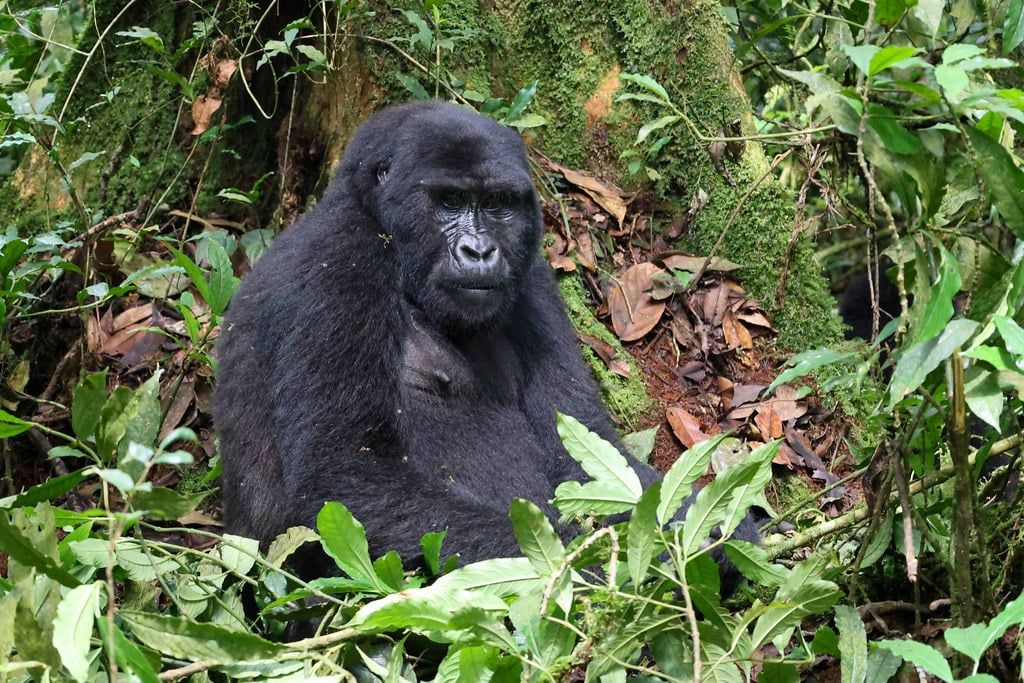
Then the radio crackles and the pace changes. You drop your packs, cameras out, flash off, and walk the last stretch into the family. What follows is exactly one hour: a silverback the size of a small car stripping vegetation a few metres away, mothers nursing infants, juveniles wrestling in the vines. The gorillas mostly ignore you — habituation means generations of them have grown up seeing humans keep a respectful distance. Keep to it: 10 metres minimum, voices low, no eating or drinking near the group. Afterwards you hike out and collect your trek completion certificate at the trailhead.
How Hard Is Gorilla Trekking? Fitness, Altitude and Porters
Genuinely hard, occasionally brutal, and manageable for most people who prepare a little. The honest picture: 2–8 hours of steep, muddy, slippery trail through dense vegetation, in humidity, with nettles on the slopes and stream crossings in the valleys. Guides set a moderate pace with rest stops, so this is a stamina problem rather than a speed problem — if you can walk uphill for three or four hours with breaks, you're fit enough.
Altitude is the part you can stop worrying about. Bwindi spans 1,160–2,607 m and its gorillas live below about 2,600 m, while the Virunga parks (Rwanda, Mgahinga, DRC) range at 2,500–3,400 m — so altitude sickness is rarely the limiting factor here in the way it can be in Rwanda. The morning air at 2,000-plus metres is cool rather than thin.
Prepare by walking hills or stadium stairs with a loaded daypack in the month before you travel, and break in your boots properly — blisters end more treks than fitness does. Then be honest at the briefing so the rangers can match you to a nearer family. For trekkers who can't manage the walk at all, sectors arrange a sedan chair carried by four trained porters (about $300–500) — book it well in advance.
Hire the porter regardless. For $10–25 they carry your daypack, steady you on slick descents and haul you up the steeper pitches — and the fee goes straight to local families, including reformed poachers, which is how the community around Bwindi earns a stake in the gorillas' survival. It's $20 well spent even if you never need the help.
The packing list, condensed:
- Waterproof hiking boots, broken in — plus gaiters in the wet season
- Long trousers and long sleeves (nettle protection)
- Proper rain jacket; it can rain any day
- Garden gloves for grabbing vegetation
- Daypack with 2–3 litres of water and snacks
- Camera, no flash, plus spare batteries and a dry bag
- Insect repellent, and cash for porters and tips
Best Time to Go Gorilla Trekking in Bwindi
June to August and December to February are the drier windows: firmer, less slippery trails, better light for photography, and easier driving on the murram access roads. June–August is the busiest period of the year; December–February gets nearly the same weather with slightly thinner crowds. We cover the trade-offs in more detail in our best time to visit Bwindi guide.
March to May is the wettest stretch, with late September through November close behind. Downpours turn the steep trails to mud soup and the access roads to a crawl — but the rains also bring lodge discounts, occasional UWA permit promotions, and a quieter forest. One compensating quirk: in the wet months gorillas tend to feed at lower elevations, so treks can actually be shorter.
Whatever the calendar says, this is a rainforest — rain falls in every month, including the dry ones. Pack rain gear in July and pack it in April. Season matters far less for the experience than your sector choice and your fitness, and sighting success stays high year-round. The one rule that holds in every season: book the permit around the season, not after it, because June–August dates sell out first.
Rules and Gorilla Etiquette
The rules exist mostly for one reason: mountain gorillas share roughly 98% of our DNA and catch our diseases, and respiratory infections have killed wild gorillas elsewhere. Every rule at the briefing traces back to keeping you from passing something to the family.
- Stay at least 10 metres from the gorillas
- One hour with the family, no extensions
- Stay in a tight group, keep voices low
- No flash photography
- No eating, drinking or smoking near the gorillas
- Carry out every scrap of litter
If a gorilla charges — rare, but it happens — do not run. Crouch down slowly, avoid direct eye contact and follow the guide's instructions; a charge is usually bluff, and a calm group ends it in seconds. The illness policy is the rule that catches people out: arrive at the briefing with flu or cold symptoms and UWA can bar you from trekking. Declare it honestly, and consider insurance that covers a sick-day refund, because the permit itself won't.
Beyond the Trek: Batwa, Birding and Safari Add-Ons
Most visitors give Bwindi exactly one day for the trek and leave. The forest and its surroundings deserve at least one more.
The Batwa experience
The Batwa lived in this forest as hunter-gatherers for centuries until the 1991 gazettement evicted them to protect the gorillas. Today Batwa guides lead the Batwa Trail Experience ($40, booked in advance) — fire-making, medicinal plants, honey collection, ending at a cave — and Buhoma and Nkuringo both run village walks with the Bakiga people, including banana-beer brewing and craft cooperatives. The fees go directly to families living at the forest edge. After a morning with the gorillas, it's the other half of the story.
Birding and forest walks
With 347+ bird species and 22 Albertine Rift endemics — African green broadbill, Grauer's swamp warbler, Shelley's crimson-wing — Bwindi ranks among Africa's top birding destinations, and dawn on the Ruhija trails is a serious birder's morning. Day nature walks cost $40 for foreign non-residents; the long Buhoma–Nkuringo traverse ($60) crosses the entire park on foot through prime gorilla habitat.
Safari combinations
Two pairings dominate most itineraries. Queen Elizabeth National Park's Ishasha sector — famous for lions that drape themselves over fig trees — is a 2–3 hour drive from Buhoma, so a savannah game drive slots naturally before or after the trek. Lake Bunyonyi, a malaria-free highland lake dotted with 29 islands about 1.5–2 hours from Ruhija, is the classic place to decompress with sore legs afterwards. Chimp tracking in Kibale Forest makes it a full primate circuit if you have a week.
A 3-day skeleton itinerary
- Day 1 — Travel to your sector (fly to Kihihi/Kisoro, drive from Entebbe, or the Kigali shortcut); lodge near the briefing point; early night.
- Day 2 — 7:30 am briefing, trek, one hour with the family, certificate; celebrate at the lodge.
- Day 3 — Batwa cultural experience, birding walk or transfer via Ishasha / Lake Bunyonyi on the way out.
Kigali-based travelers compress this to two days: drive up on day one, trek on day two, back in Kigali by evening. It works, but three days leaves room for the forest itself. To see how operators assemble these, compare Bwindi tours and match one to your dates.
What Your Trip Really Costs
The $800 permit is less than half of what most people spend. Here's the honest breakdown, anchored to UWA's official tariff.
First, a correction to figures you'll read elsewhere: the permit does include park entrance — for the trek day. A separate entrance fee ($40 foreign non-resident, $30 foreign resident, UGX 20,000 East African) applies only to additional days in the park, such as a birding walk the morning after your trek. Current fees are listed on our Bwindi hours and entry fees page, and vehicle entry for a foreign-registered saloon is $40 per 24 hours if you're driving in.
Lodging runs in three bands: budget $50–100 per person per night, mid-range $100–300, and luxury from $600 up to $1,500 or more. Add the porter at $10–25, pooled tips of $15–20 for rangers and trackers, $5–10 for your porter, and $10–15 per day for a driver-guide if you have one.
Put together, a mid-range 3-day trip — permit, two nights, road transport from Entebbe, porter and tips — lands around $1,400–1,800 per person, excluding international flights. Fly in and add several hundred dollars; package tours start at roughly $1,800. Budget roughly $2,500 all-in from mid-range upward if you add Ishasha or Lake Bunyonyi.
Where does the money go? Gorilla tourism is what pays for Bwindi: permit revenue funds ranger patrols and monitoring, includes a community levy, and underpins the livelihoods of one of tropical Africa's most densely settled rural areas around the park boundary. The fee is high because the gorillas can only sustain 8 visitors per family per day — scarcity, not luxury, sets the price.
Gorilla Trekking FAQs
How much does a Bwindi gorilla trekking permit cost?
US$800 for foreign non-residents, US$700 for foreign residents, US$500 for Rest of Africa and UGX 300,000 for East African citizens under the current UWA tariff. The Gorilla Habituation Experience permit is US$1,500 (foreign non-resident) for up to four hours with a semi-habituated family in Rushaga. Book 3–6 months ahead, or 6–12 months for the June–September and December–February peak.
What is the minimum age for gorilla trekking in Bwindi?
15 years, set by the Uganda Wildlife Authority for safety and disease-risk reasons and enforced with passport checks at booking and at the trailhead. There is no upper age limit — seniors trek regularly, especially from Buhoma, with a porter ($10–25) to carry packs and steady them on slopes.
How hard is gorilla trekking in Bwindi, and how fit do I need to be?
Treks run roughly 30 minutes to 8 hours over steep, muddy forest trails, so moderate fitness — comfortable walking uphill for a few hours with breaks — is enough. Bwindi's gorillas live below about 2,600 m (the park spans 1,160–2,607 m), lower than the 2,500–3,400 m Virunga parks, so altitude sickness is rarely the limiting factor. Tell the rangers your fitness level at briefing; they assign families accordingly.
What are the chances of actually seeing the gorillas?
Very high — an estimated 95–98% of treks find their family, in every season, because advance trackers locate each family from its overnight nests and radio the position to your guide. In the rare miss, some operators arrange a partial refund or an alternative trek, so check the policy when booking.
Can I choose which gorilla family or sector I trek?
Partly. Your permit locks you into one of the four sectors — Buhoma, Ruhija, Rushaga or Nkuringo — so that choice is yours at booking. The specific family is decided by rangers on the morning of the trek, based on where each family currently is and the fitness of your group of eight.
When is the best time to go gorilla trekking in Bwindi?
June–August and December–February are the driest months, with firmer trails and the highest demand. Trekking runs year-round with high sighting success in every month; the wet seasons (March–May, late September–November) bring lodge discounts, occasional permit promotions, thinner crowds and sometimes shorter treks as gorillas feed lower down the slopes.
Is gorilla trekking in Bwindi safe?
Yes. Every group walks with armed UWA ranger escorts, and the families you visit have been habituated over years. The real risks are environmental — slips on mud, stinging nettles, rain — so wear proper boots, hire a porter, and follow the guide's instructions, especially if a gorilla charges: crouch slowly, don't run, avoid direct eye contact.
Is gorilla trekking better in Uganda or Rwanda?
Uganda's permit costs $800 against Rwanda's $1,500, and Bwindi holds around 20 habituated families across four sectors plus the habituation experience, versus roughly a dozen groups in Rwanda's Volcanoes National Park. Rwanda counters with easier logistics and shorter drives from Kigali — though Bwindi's southern sectors are themselves only a 3–4 hour drive from Kigali. DRC permits are cheaper still (around $400–450) but Virunga has repeatedly closed due to instability.
Sources
- Uganda Wildlife Authority — Bwindi Impenetrable National Park (ugandawildlife.or
- Uganda Wildlife Authority — Conservation Tariff July 2024–June 2026 (ugandawildl
- UNESCO World Heritage Centre — Bwindi Impenetrable National Park (whc.unesco.org
- International Gorilla Conservation Programme — Bwindi–Sarambwe gorilla census (i
- Wikipedia — Bwindi Impenetrable National Park